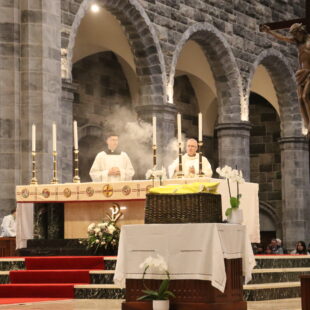
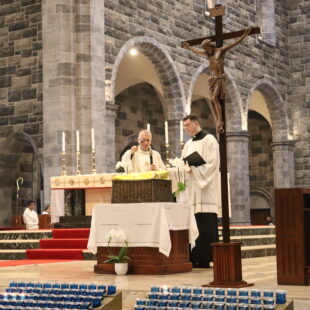
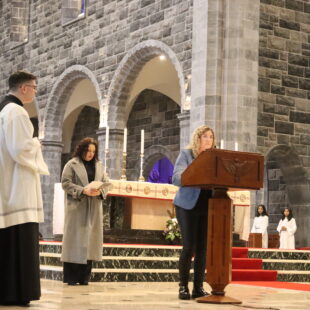
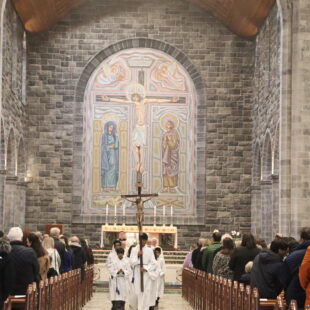
Last Sunday we come together from across the diocese to mark fifty years of Primary School Boards of Management. This gathering recognises the quiet, faithful work of generations of people who have taken responsibility for the care and leadership of our Catholic primary schools.
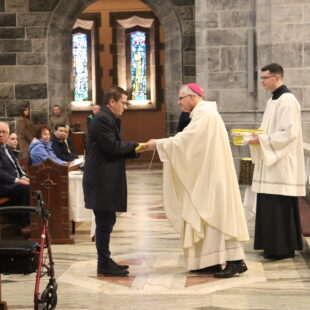
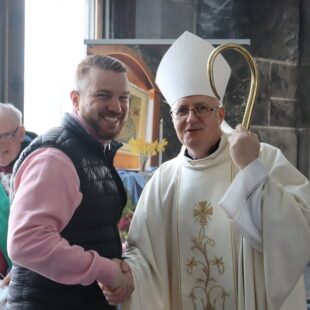
Bishop Michael presented each school with a Papal flag. This gift reminds us that our schools belong to a wider Church and share in its mission of faith, learning, and service. It is a sign of unity with the Holy Father and a reminder that Catholic education is part of the living life of the Church, here and now.
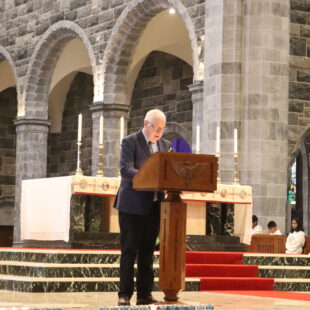
Homily
“I suspect that this will rightly involve significant divestment of schools. We could well ask ourselves: in ten or twenty years’ time, will half of the schools represented here today be Catholic schools? I suspect that the future will also require a renewed commitment to ensuring that the schools that remain Catholic truly serve and are allowed to serve the Catholic community and those non-Catholics who value the Catholic vision of education.” – Bishop Michael
Each year, those responsible for the Oxford English Dictionary add new words to their already impressive collection of over half a million entries. I find the exercise interesting. It provides a snapshot of trends in our contemporary culture that have been brought to expression in language. Last year, the list included new words such as “mis-click,” which is an accidental click of your mouse or touch of the screen when using your computer, tablet, or smartphone. With a nod to regional variations of language and for those partial to a late-night takeaway, “spice bag” also made the list. A spice bag is described as “a popular Irish takeaway meal of chips and deep-fried chicken.”
Now, each year one word is awarded the title “Oxford Word of the Year.” Last year this honour went to the idea of “brain rot,” defined as a slang term that refers to “the impact of consuming excessive amounts of low-quality online content, especially on social media.” I sincerely hope that this homily will not end up in this category! Tá súil agam nach mbeidh an tseanmóir seo sa chatagóir sin!
Now, if we were to apply a similar exercise to contemporary religious or church circles—especially to the Catholic Church in the last year—I believe there is one word that would easily win the title “Church Word of the Year.” It is an ancient word that has been rediscovered and repurposed to express what we as a Christian community should look like in the twenty-first century. Can you guess what it is? For me, the current “Church Word of the Year” is without doubt “Synodality.” While many feel the word itself is a rather technical term that fails to engage the average churchgoer’s imagination, I think it deserves a closer look. Is fiú stopadh agus machnamh a dhéanamh air.
The word “Synodality” comes from two Greek words: “syn,” meaning “together,” and “odos,” meaning “a way” or “a path.” Simply put, it means “walking together.” Ag siúl an bhealaigh le chéile. When applied to the Church, it means all of God’s people, you and I, walking together, helping each other, talking things out as we listen for the voice of the Holy Spirit who guides us on the journey.
“Synodality” is not a new idea; it is an ancient concept whose inherent richness has been gradually rediscovered in the wake of the Second Vatican Council (1962–1965). It emphasises the fact that laity and clergy share a common baptism and a common purpose. No one is better than the other. All have a responsibility for the faith. Though called to different tasks in the vineyard of the Lord, priests and people have a sacred, Gospel-inspired responsibility to walk and work together to shape our lives and our world for the better.
You might ask, what has all this to do with our gathering here today to mark Catholic Schools Week 2026 and to celebrate the fiftieth anniversary of the introduction of Primary School Boards of Management in Ireland? Before 1975, Catholic schools were generally managed solely by the local parish priest. Just ten years earlier, the Second Vatican Council had concluded in Rome. It was by far the most important event in the Catholic Church for hundreds of years. It brought new insights in its wake.
By the early seventies, the Council’s emphasis on a shared responsibility for the faith between clergy and laity was beginning to make itself felt across the world. Bhí an eaglais ag éisteacht agus ag foghlaim. Irish society was changing too. There was a growing desire, from within the Church and from outside the Church, for a more participatory mode of management of schools. After a fruitful Church–State dialogue, local Boards of Management as we know them today, composed of representatives of all the key stakeholders, were eventually introduced to manage Catholic schools.
Back in 1975, the word or idea of “Synodality” was not yet in use; however, the introduction of Boards of Management was, and still is, perhaps the greatest exercise in synodality the Catholic Church in Ireland has ever undertaken. Ag suí ag an mbord céanna. At the one table, priest and lay person, teacher and parent, principal and community nominee would journey together to discern, direct, and manage their local Catholic school.
What is more, they would do this voluntarily. They would do it for the common good, in that spirit of generosity to which all followers of Jesus are called. Seirbhís a dhéantar le grá.
Today gives us an opportunity to thank all members, past and present, of Boards of Management who served and continue to serve our Catholic school communities—thousands and thousands giving freely of their expertise and their time; thousands upon thousands of hours given to support the mission of local Catholic primary education. Go raibh míle maith agaibh uilig.
Today is also a day to affirm the unique richness of the vision of Catholic education. The readings we have just listened to present us with the powerful symbols of light and darkness. They compare the presence of God to a light that burns brightly, overcoming every darkness. They speak of God’s wisdom as a beacon of hope that points us in the right direction on the road of life.
The readings remind us that to have faith in life is a plus, not a minus. It is something inherently positive, a good gift that we instinctively want to pass on to those around us, especially those we love and care for—our families and our children. It is here that the Catholic school comes into its own, providing a faith-inspired environment to assist and support parents in handing on that light of faith and the vision of life that goes with it to their children. Oideachas don saol, ní don scrúdú amháin.
Today, I pray and I hope that, as a Catholic faith community, we might be as brave as those in the mid-seventies were—brave to take new and bold initiatives when it comes to Catholic schools for the next fifty years. I suspect that this will rightly involve significant divestment of schools. We could well ask ourselves: in ten or twenty years’ time, will half of the schools represented here today be Catholic schools?
I also suspect that the future will require a renewed commitment to ensuring that the schools that remain Catholic truly serve and are allowed to serve the Catholic community and those non-Catholics who value the Catholic vision of education. As a faith community, we will need to come alongside our Catholic school communities and walk closer beside them, taobh le taobh, in the noble task of Catholic education.
Today, it is good that we stop and give thanks for the last fifty years of that great exercise in synodality—in faith-inspired walking and working together—that Boards of Management represent. As we do so, let us ask God’s blessing on all our Boards of Management and on all our Catholic school communities as we continue on the journey, discerning together a bright future for the precious pearl that Catholic education truly is. Go dtuga Dia a bheannacht dúinn ar an mbealach.
Now, I hope what I have said has not contributed any further to your “brain rot”! Amen.